
The question isn't whether AI will change your job, but if you’ll be ready when it does.
We're at an inflection point. According to McKinsey's latest State of AI research, 88 percent of organizations now report regularly using AI in at least one business function, up from 78 percent just a year ago. More striking: 62 percent are already experimenting with AI agents—autonomous systems capable of planning and executing multiple steps in a workflow.
The numbers reveal an unmistakable trend. OpenAI's State of Enterprise AI report shows that over one million businesses now actively use AI tools, with ChatGPT message volume growing eightfold year-over-year. Even more telling: API reasoning token consumption per organization has skyrocketed 320 times, demonstrating that organizations aren't just experimenting—they're integrating AI deeply into their operations.
Enterprise workers using AI report saving 40 to 60 minutes per day on average, with heavy users saving more than 10 hours per week. And 75 percent of workers report completing tasks they previously couldn't perform at all, like coding, data analysis, or creating custom workflows.
We're in a narrow transition period. Right now, professionals who can build and apply AI agents stand out. In 2026, that advantage will turn into an expectation. As organizations move from experimentation to integration, the ability to design and deploy agents will increasingly be assumed—not rewarded as exceptional.
The professionals who will thrive in 2026 will be those who know how to build AI agents that solve real business problems.
At AI Academy, we define an AI agent simply: an AI system that can take actions using different tools and some degree of autonomy. This straightforward definition cuts through the hype and focuses on what matters—the practical capability to get things done.
From a technical perspective, AI agents are programs where Large Language Model outputs directly control the workflow of an application. Unlike traditional software with fixed logic, agents can make decisions, use tools, and adapt their behavior based on context.
Think of an agent as a digital colleague that can access your systems, make informed decisions, and take action on your behalf. It's the difference between having a calculator and having a financial analyst.
As AI becomes embedded in everyday workflows, the ability to build agents is turning into a new kind of workplace fluency, similar to how spreadsheet skills became essential in the 1990s.
Here's the simple truth: if your professional value depends on thinking and making decisions, you need to understand how to build AI agents. This isn't reserved for engineers—it's a cross-functional capability becoming essential across every knowledge-based role.
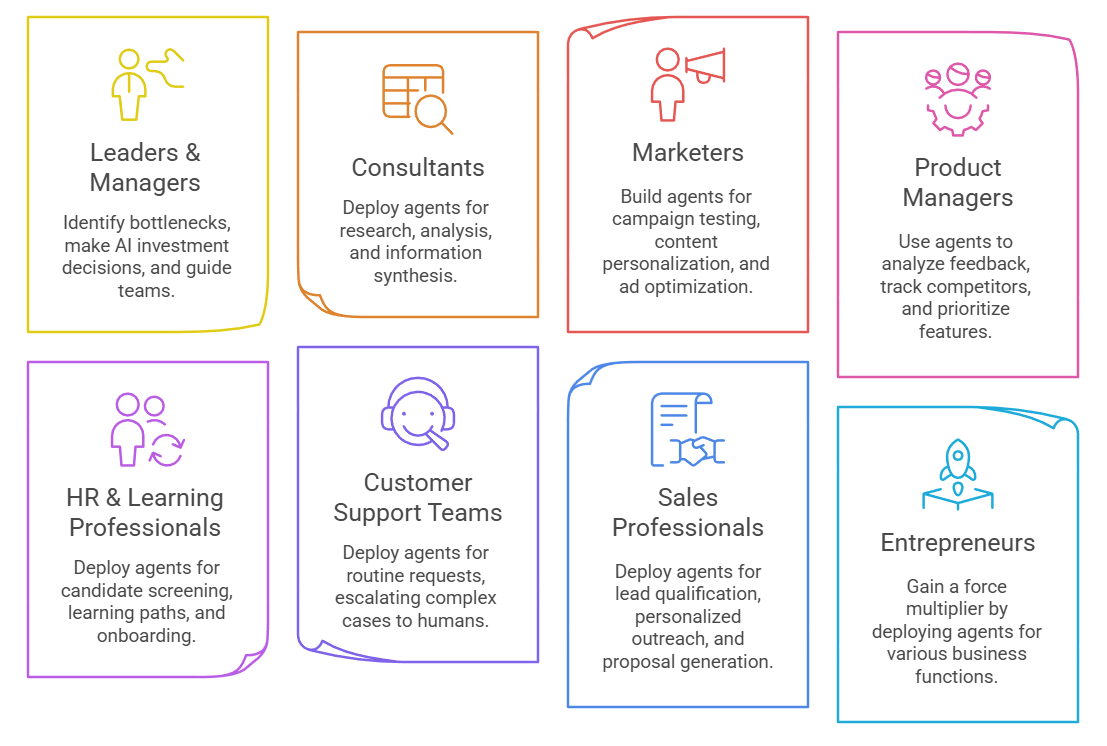
There's a crucial difference between using AI tools and building AI systems. Those 10 hours per week that heavy AI users save aren't just from using ChatGPT better—they're from building agents that automate entire workflows. Anyone can use ChatGPT. Far fewer can design an agent that solves a specific business problem, integrates with existing workflows, and delivers reliable results. That's the skill that creates career differentiation.
As agent capabilities become standard across industries, the professionals who understand how to build them will set the pace. Those who don't will be working to catch up.
Not all AI agents are the same. They exist on a spectrum of capability, often described as levels of agency:
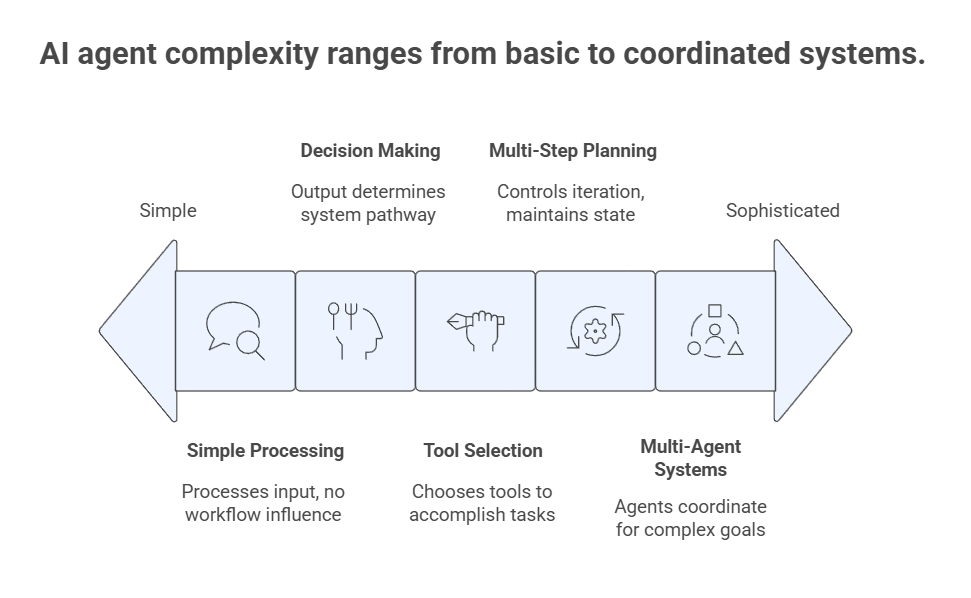
Level 1 - Simple Processing: The AI processes input but doesn't influence workflow decisions. This is basic text generation or analysis with no decision-making.
Level 2 - Decision Making: The AI output determines which pathway the system follows. Think of an agent that routes customer inquiries to appropriate departments based on content analysis.
Level 3 - Tool Selection: The AI can choose and use various tools to accomplish tasks. An agent at this level might decide whether to search a database, call an API, or generate content based on the situation.
Level 4 - Multi-Step Planning: The AI controls iteration and can maintain state across multiple steps. These agents can handle complex, multi-stage tasks that require planning and adaptation.
Level 5 - Multi-Agent Systems: Multiple specialized agents work together, coordinating their efforts to accomplish sophisticated goals.
The key insight? You don't need to reach Level 5 to create significant value. Even Level 3 agents can transform workflows and save hundreds of hours annually.
Building effective AI agents requires a specific skillset that combines technical understanding with business insight:
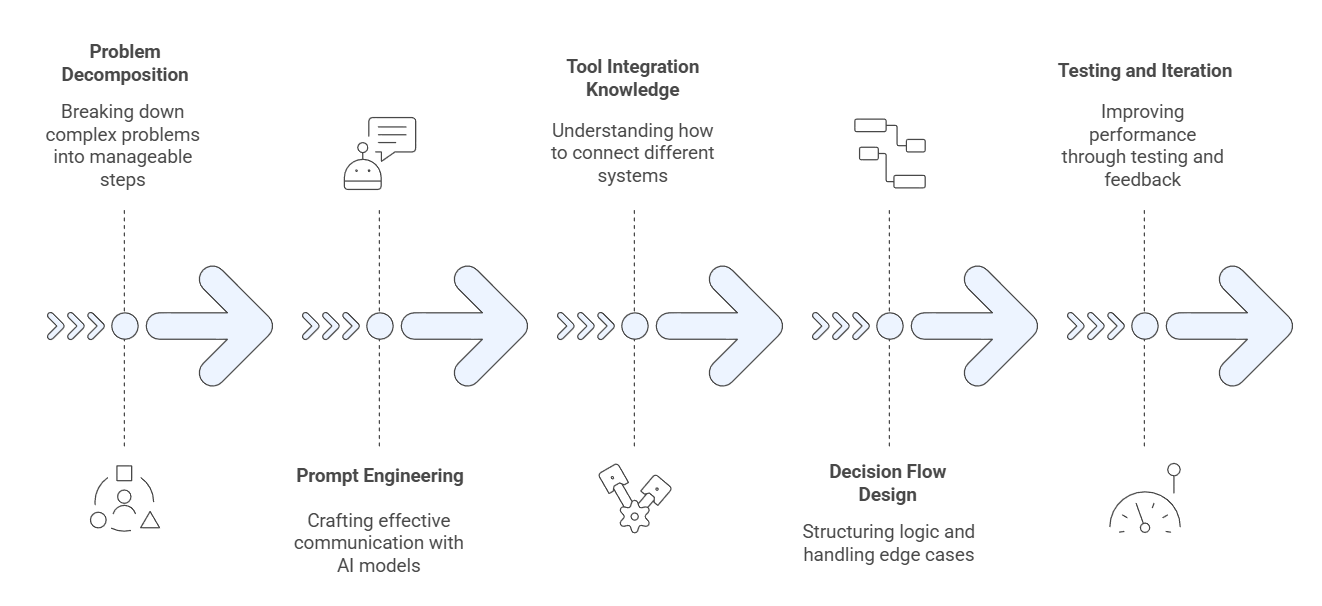
1. Problem Decomposition
The foundation of agent building is knowing how to break complex problems into steps an AI can handle. This isn't coding—it's logical thinking applied to business processes.
2. Prompt Engineering
Understanding how to communicate effectively with AI models determines the quality of your agents. This includes knowing when to be specific versus general, how to structure context, and techniques for reliable outputs.
3. Tool Integration Knowledge
Agents become powerful when they can access and use tools. This means understanding APIs, data structures, and how different systems can connect—but at a conceptual level, not necessarily implementation.
4. Decision Flow Design
Creating agents that make good decisions requires understanding how to structure logic, handle edge cases, and implement appropriate fallback mechanisms. Equally important is designing human oversight—knowing when agents should flag uncertain decisions for review and where to build in intervention points.
5. Testing and Iteration
Perhaps most important: knowing how to test agent behavior, identify failure points, and systematically improve performance.
The good news? You don't need a computer science degree to build effective AI agents.
The path to competence follows four key steps:
If building AI agents is a skill that will matter in 2026, the question becomes: what's your plan to develop it?
At AI Academy, we've trained over 12,000 professionals in practical AI skills, maintaining a 4.83/5 average course satisfaction rating and 4.7/5 on Trustpilot. Our approach to teaching agent building is grounded in two principles: outcome-focused learning and hands-on practice.
Our AI Agent Bootcamp takes a different approach from typical AI courses. Rather than teaching abstract concepts, we guide individuals or teams through building actual AI agents that solve real business problems. In seven weeks, you'll go from understanding basic concepts to deploying working agents.
The bootcamp combines expert instruction with practical application. You'll learn the fundamentals of agent architecture, master prompt engineering techniques, understand tool integration, design decision flows, and build your own agent project from concept to deployment. Throughout the program, you'll receive personalized coaching and feedback from AI experts who understand both the technology and business applications.
Beyond the bootcamp, AI Academy Membership provides comprehensive support for your ongoing development. Members get unlimited access to all certificate programs, one-on-one coaching calls with AI experts, bi-monthly expert sessions on the latest developments, and year-round access to our community of AI practitioners.
Ready to start building the skills that will matter in 2026? Learn more about AI Academy Membership and join the professionals who are already shaping the future of work with AI agents.
Learn More About AI Academy Membership
Here are answers to the most common questions we hear about learning to build AI agents:
Do I need coding experience to build AI agents?
Not necessarily. While coding knowledge can be helpful for advanced applications, many modern tools and platforms enable agent building without writing code. The key skills are logical thinking, problem decomposition, and understanding how to structure workflows—not programming syntax. Our AI Agent Bootcamp teaches agent building to professionals without coding backgrounds.
How long does it take to learn AI agent building?
The timeline varies based on your goals and starting point. Most professionals can start building basic agents within 2-3 weeks of structured learning, while complex multi-agent systems could require several months of development and testing. Our 7-week AI Agent Bootcamp takes participants from fundamentals to deploying working agents.
What types of problems can AI agents solve?
AI agents excel at tasks involving information processing, decision-making based on defined criteria, coordination between multiple systems, repetitive workflows that require some judgment, and customer interactions that follow general patterns. They're less effective for tasks requiring deep creativity, complex ethical judgment, or understanding subtle human emotions. McKinsey's research shows agent use is most common in IT, knowledge management, and customer service functions.
Should AI agents operate fully autonomously or with human oversight?
The most effective AI agents maintain human-in-the-loop design, especially for high-stakes decisions. This means building agents that can flag uncertain situations, provide transparency into their reasoning, and allow human intervention at critical points. The goal isn't complete automation—it's intelligent collaboration where AI handles routine tasks and humans focus on judgment, creativity, and strategic decisions. When building agents, always consider where human oversight adds value and design those checkpoints into your workflows. At AI Academy, we teach responsible agent development that balances automation with appropriate human control.
How much does it cost to build and run AI agents?
Costs vary significantly based on agent complexity, usage volume, and implementation scope. Key cost categories include development resources, infrastructure, API usage (especially for LLMs), maintenance, and ongoing optimization. The specific cost structure depends on your implementation scale and complexity. However, the key consideration is ROI, which for most organizations far exceeds operational costs. Our AI Academy courses cover practical techniques for building cost-effective agent systems.
What's the difference between building an AI agent and using ChatGPT?
ChatGPT is a tool you interact with directly for single tasks. An AI agent is an automated system that can operate independently, make decisions, use multiple tools, and handle complex multi-step workflows without human intervention. Building agents means creating these autonomous systems that solve ongoing business problems.
Can AI agents work with my company's existing systems?
Yes, when designed properly. Agents can integrate with existing systems through APIs, database connections, and other standard integration methods. The key is understanding your systems' capabilities and designing agents that work within those constraints. This is part of what we teach in our training programs.
What industries benefit most from AI agents?
According to McKinsey's State of AI research, technology, media and telecommunications, and healthcare sectors most widely report using AI agents. However, agents create value across industries. Professional services benefit from agents handling research and analysis. Customer service operations use agents for inquiry routing and response. Marketing teams deploy agents for content creation and campaign optimization. The common thread is knowledge work involving data processing and decision-making.
How do I know if an AI agent is right for my problem?
Good candidates for AI agents share certain characteristics: the task is repeatable with some variation, it involves processing information and making decisions, success criteria can be defined clearly, the problem is significant enough to justify the development effort, and human oversight is possible for critical decisions. If your problem fits these criteria and you're seeing competitors or peers in your industry deploying similar solutions, an agent is likely a good fit.
What ongoing maintenance do AI agents require?
AI agents need regular monitoring to ensure they continue performing correctly, updates when business processes or requirements change, periodic review of decision quality and outputs, and refinement based on user feedback and changing needs. Well-designed agents require less maintenance than custom software, but they're not completely hands-off. Organizations scaling AI successfully treat this as an ongoing capability development, not a one-time implementation.
Where can I learn to build AI agents effectively?
Effective agent building requires structured learning that combines theory with hands-on practice. The AI Academy Membership provides comprehensive training through our AI Agent Bootcamp, where you'll build real agents under expert guidance. You'll also get access to ongoing support, regular expert sessions, and a community of practitioners developing similar skills.


.png)
.png)