
We surveyed 178 people about how they actually use AI at work. The patterns that emerged aren't really about AI itself but more about how companies adopt any new technology platform when the innovation cycle runs faster than the procurement cycle.
70% of people learned to use AI from YouTube and free resources. 30% paid for training themselves. 13% got training from their employer.
Meanwhile, 63% of companies now pay for AI tool licenses. So there's a 5x gap between companies buying tools and companies teaching people to use them.
This isn't a new trend, the same pattern happened with smartphones (people bought iPhones before IT approved them), with SaaS (people used Dropbox before IT knew what Dropbox was), and with collaboration tools (Slack spread inside companies before anyone asked permission).
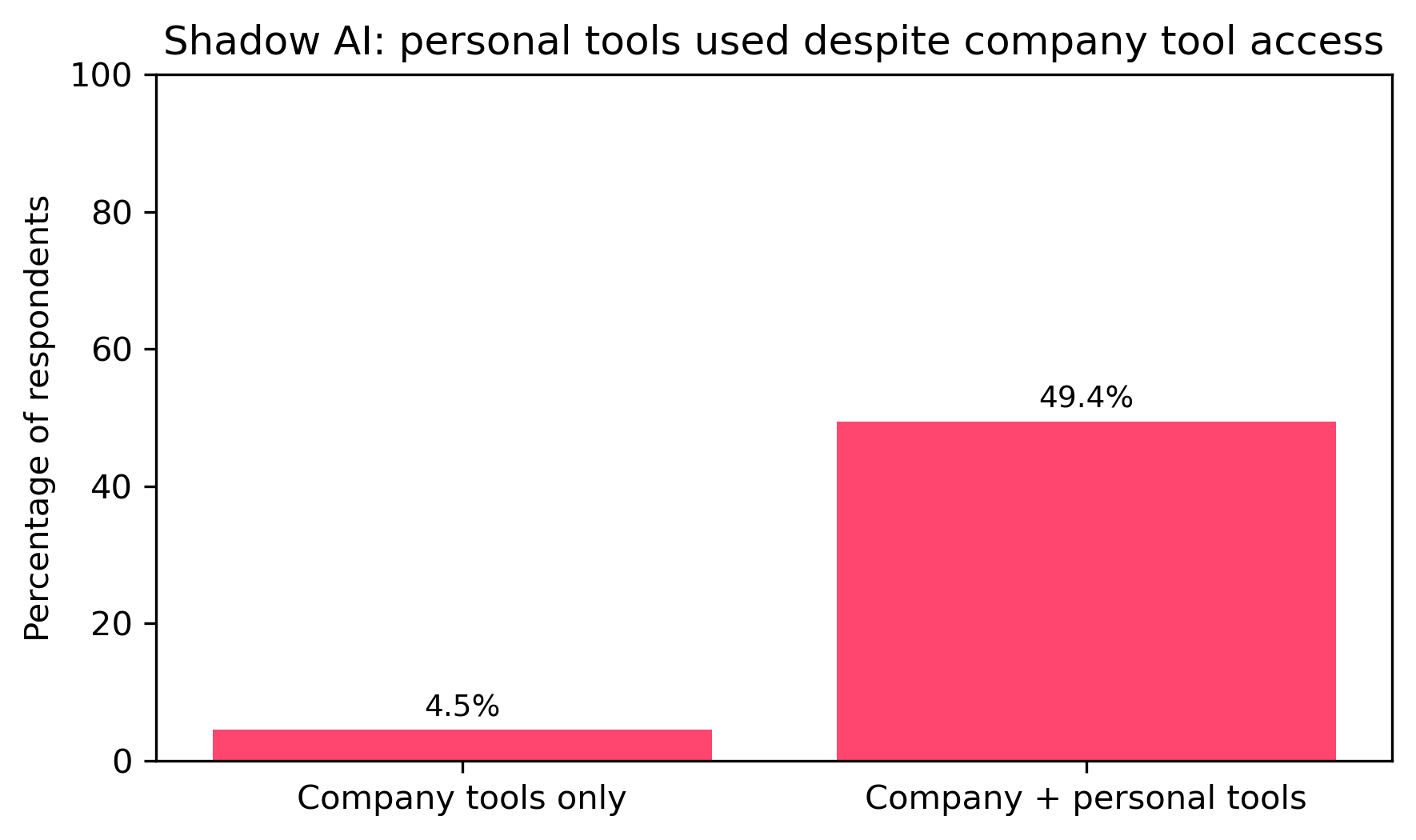
What's interesting is what happens when companies do provide the tool: 49% of people with company-provided AI tools also use their own personal tools. Not instead, in addition to, and yes they likely use it for their tasks too.
This number tells you something about product-market fit at the feature and usage level.
If people are already paying for a tool, and you give them a different tool and see half of them keep paying anyway, this means they're solving something the approved tool doesn't solve for them either because it can’t at a tech level, or because they don’t know how to.
45% say "lack of time to learn" is their main barrier. Let’s look at the actual usage data:
The reason could be the following: Most software is designed to be learnable through use however AI tools require a conceptual model shift first. You need to understand what the tool can do before you know what to ask it to do. That's backwards from normal software UX that people are used to.
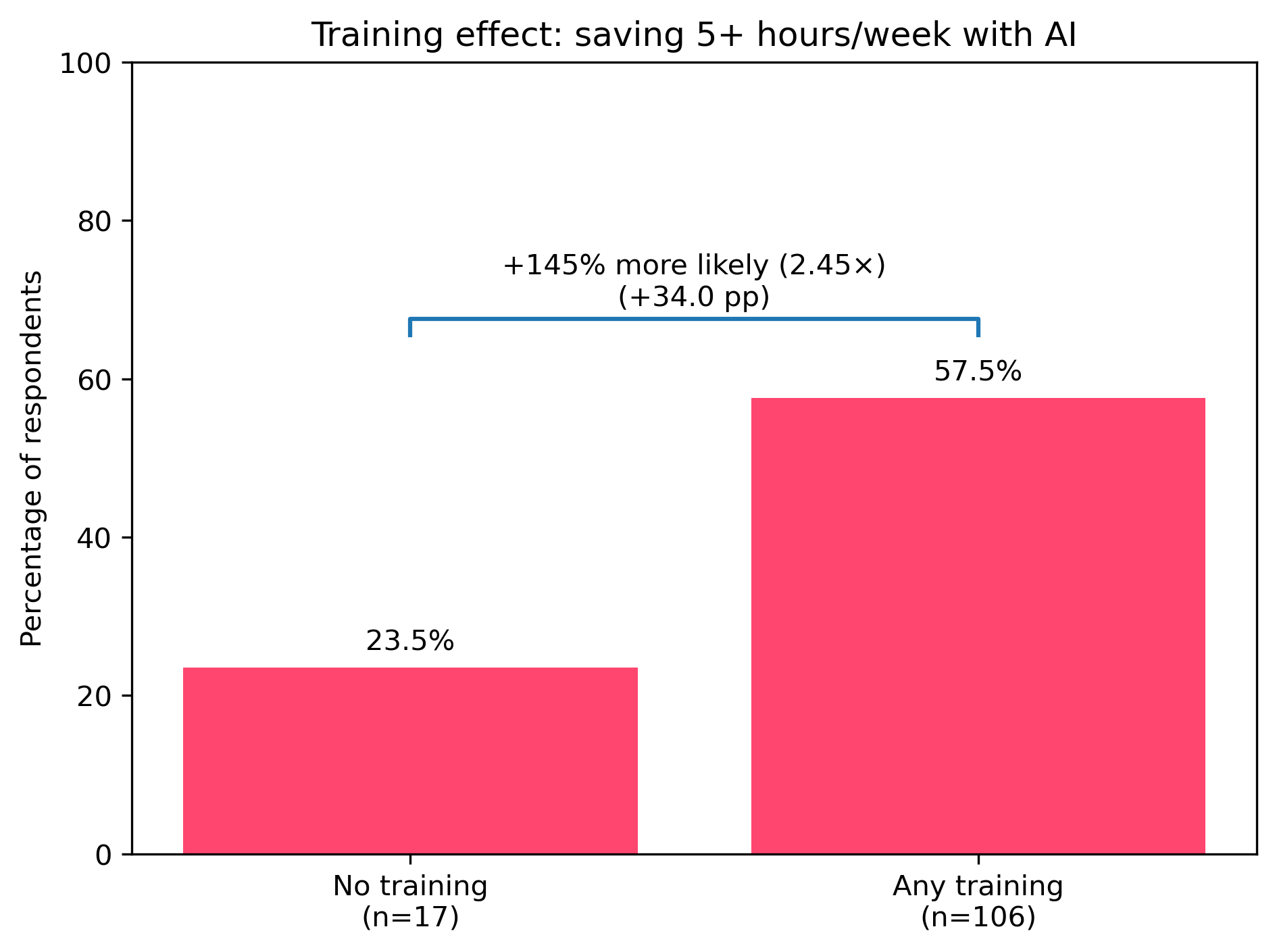
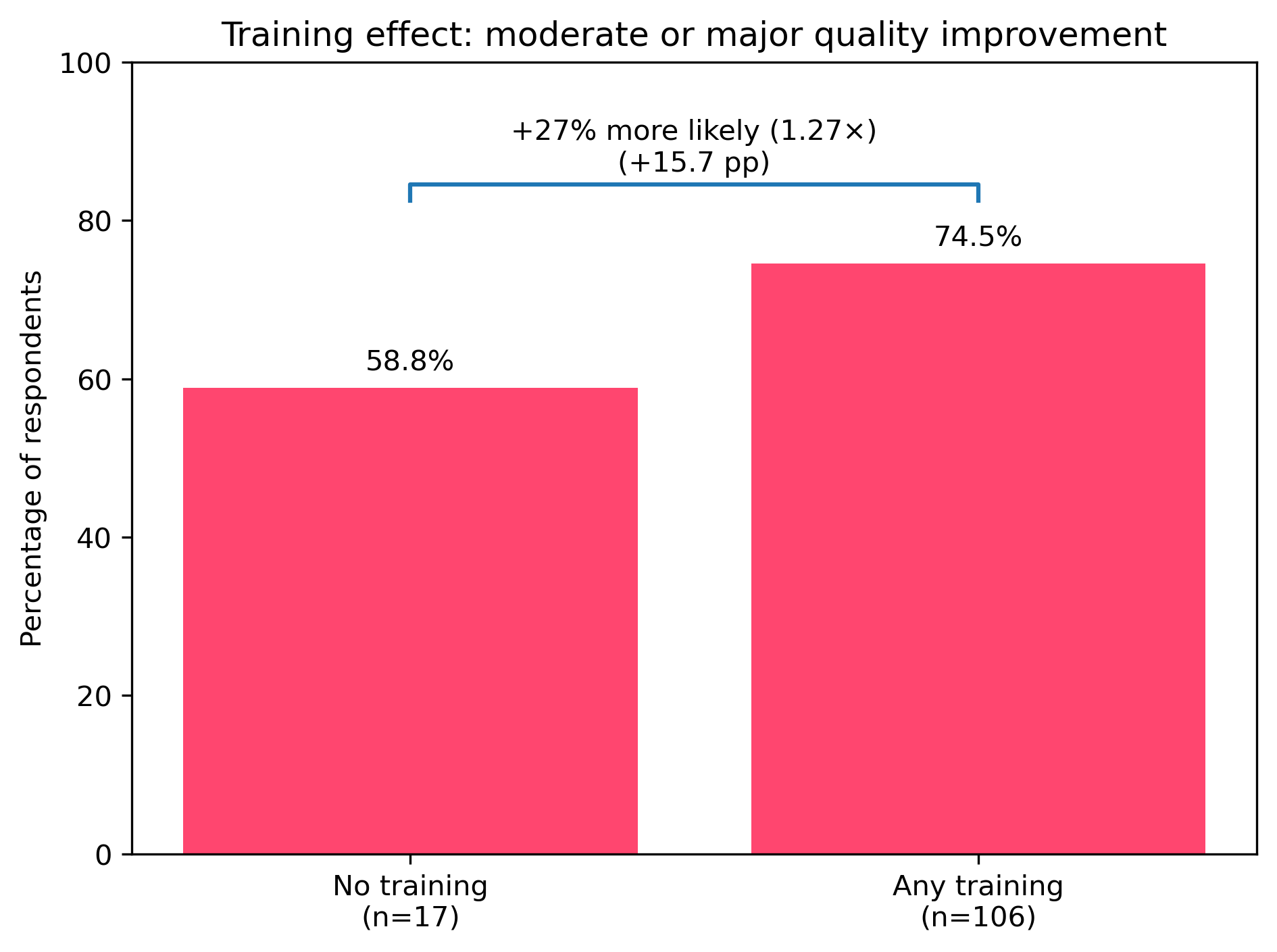
The people who received formal training in this case are 2.5x more likely to save 5+ hours weekly. because training provides the conceptual model for people to get to valuable use cases faster.
Company-provided tools:
Personal tools:
ChatGPT is 82% penetration in personal use but only 50% in company provision. That 32 point spread is the "shadow AI" surface area.
This might be the first technology wave where consumer tools are actually more sophisticated than enterprise versions. Usually enterprise gets features first and consumer gets them later. AI is running the opposite direction because consumer products can ship model updates weekly while enterprise products need compliance reviews.
Provision by company size:
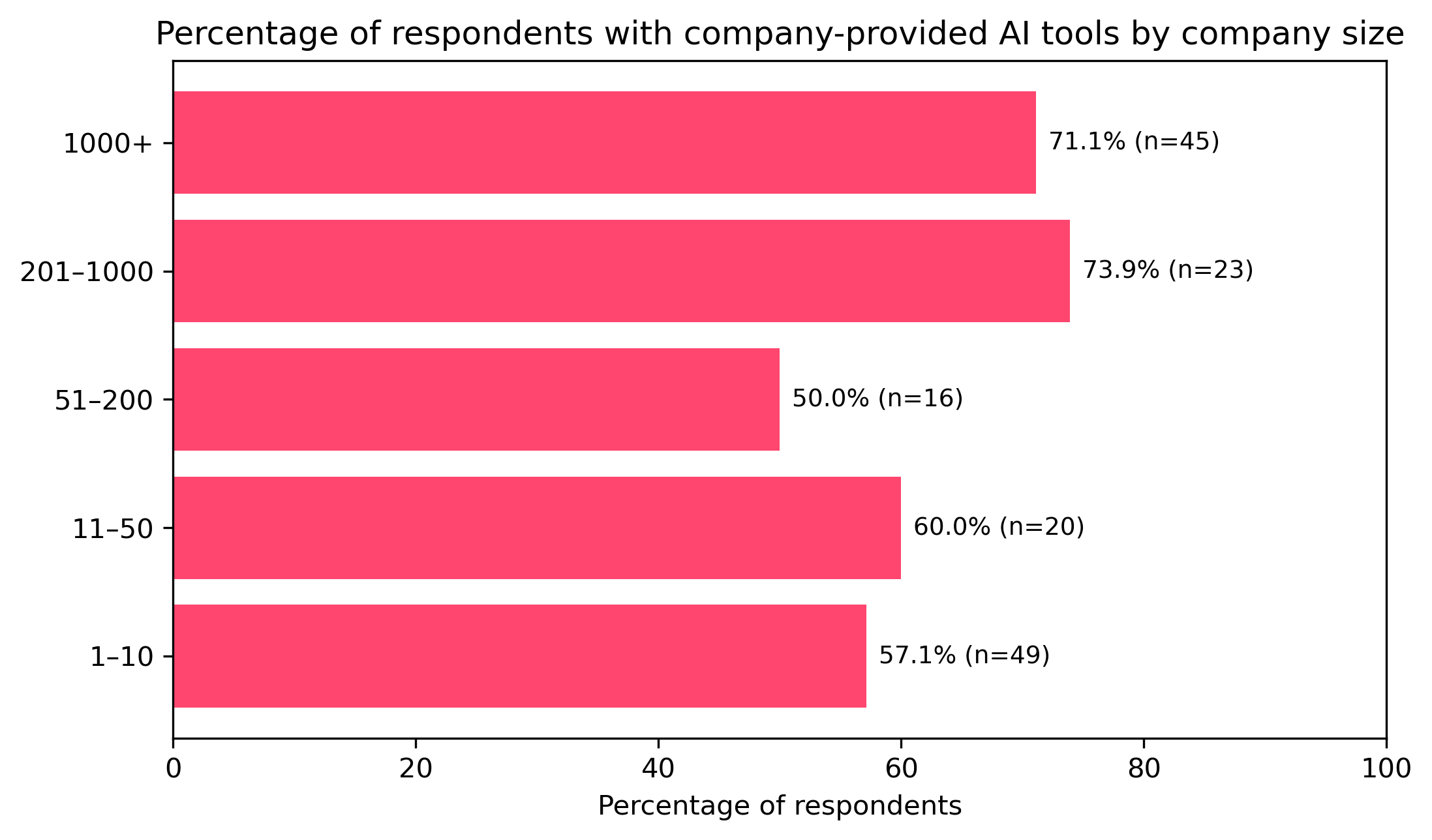
That's another surprising find from this survey. You'd expect provision rates to scale linearly with company size thinking: “bigger companies have more budget and more infrastructure” Instead, mid-size companies (201-1000) actually have the highest provision rate. Small companies can't afford licenses for everyone but don't have compliance overhead, so people just use free tools. Large companies have compliance processes that slow down procurement. Mid-size companies have enough budget to pay but not so much bureaucracy that it takes 12 months to approve a new tool category.
But in any case the support perception is flat across all sizes - 54% feel unsupported regardless of company size which is a friendly reminder that providing the tool doesn't correlate with feeling supported in using it.
But "core work tasks" has much more variation. Everyone has figured out that AI can summarize. Not everyone has figured out how to integrate it into their actual job function (our clients & students did!)
This maps to the difference between:
The productivity gains come from those rethinking workflows rather than swapping tools.
33% cite privacy/data concerns as a barrier. Yet 49% use personal tools in addition to company tools.
Enterprise IT's response is usually to block or restrict. But that just increases shadow AI and eliminates visibility. A better approach could be making the approved tools as capable as the consumer alternatives, and make the risk tradeoffs explicit rather than hidden.
We’re living a fast-forwarded enterprise technology adoption cycle
The cycle used to take 5-10 years. Now it takes 6-12 months. Companies built for the old cycle can't adapt fast enough. The solution is to build processes that assume continuous technology change rather than periodic vendor evaluation. Which is hard, because most enterprise software spend is built on 3-year contracts and annual budget cycles and vendor relationships and total cost of ownership models that assume stability.
Shadow AI is what happens when the software layer changes every 6 months and the organizational layer changes every 3 years. That gap is the whole story.
Looking to build systematic AI capabilities across your organization? Reach out to us on helin@ai-academy.com to schedule a consultation about our corporate training programs.
Why do so many people use personal AI tools in addition to company-provided ones?
Personal AI tools often offer different capabilities, faster updates, or more flexibility than enterprise versions. When 49% of employees use both company and personal tools, it suggests they're solving problems the approved tool doesn't address—either due to technical limitations or lack of knowledge about how to use company tools effectively.
How much time can I realistically expect to save using AI?
Our survey shows 79% of AI users save at least 2 hours per week, with 53% saving 5+ hours and 21% saving 10+ hours weekly. Those with formal training are 2.5x more likely to achieve the higher time savings, suggesting structured learning significantly accelerates results.
What's the biggest barrier to effective AI adoption?
While 45% cite "lack of time to learn," the data suggests the real barrier is conceptual: understanding what AI can do before knowing what to ask it to do. This is why formal training accelerates results—it provides the mental model needed to identify valuable use cases quickly.
Why don't more companies provide AI training?
Our survey found a 5x gap between companies buying AI tools (63%) and companies providing training (13%). This reflects the common pattern where organizations invest in technology but underinvest in the human infrastructure needed to use it effectively. They're optimizing for procurement speed over adoption success.
How does company size affect AI adoption and support?
Interestingly, mid-size companies (201-1000 employees) show the highest AI provision rates at 74%, compared to 50-60% for small companies and 71% for large enterprises. However, feeling supported remains flat at 54% across all company sizes, showing that providing tools doesn't guarantee effective adoption.
What's "shadow AI" and why does it matter?
Shadow AI refers to employees using personal AI tools for work without official approval. With ChatGPT showing 82% personal usage but only 50% company provision, there's a 32-point "shadow AI" gap. This matters because it creates compliance risks, eliminates IT visibility, and suggests approved tools aren't meeting user needs.
Should organizations try to prevent shadow AI usage?
Blocking shadow AI typically increases it and eliminates visibility. A better approach is making approved tools as capable as consumer alternatives while making risk tradeoffs explicit. When people understand restrictions, they're more likely to comply than when rules feel arbitrary.
How is AI adoption different from previous technology waves?
AI adoption cycles run at 6-12 months instead of the historical 5-10 years. More significantly, this may be the first wave where consumer tools are more sophisticated than enterprise versions, as consumer products can ship weekly updates while enterprise tools require compliance reviews.
What's the difference between AI substitution, augmentation, and transformation?
Substitution means AI does tasks you used to do (like writing basic emails). Augmentation means AI helps you do tasks better or faster (like enhanced analysis). Transformation means you can now do things that weren't possible before (like processing 100x more data). The biggest productivity gains come from reaching transformation level.
How can organizations close the gap between tool provision and effective use?
Focus on three areas: invest in structured training (not just tool access), help teams rethink workflows rather than just swap tools, and build processes that assume continuous technology change rather than periodic vendor evaluation. Most importantly, measure adoption by productivity impact, not just license distribution.
What skills do teams need to use AI effectively in their work?
Technical skills matter, but so do conceptual ones: understanding what AI can and can't do, identifying appropriate use cases, integrating AI into existing workflows, and developing consistent usage habits. AI Academy's training focuses on building both the skills and habits needed for sustainable impact.
How long does it take to see real productivity gains from AI?
People with formal training are 2.5x more likely to save 5+ hours weekly, suggesting structured learning dramatically shortens time-to-value. However, moving from basic usage to transformation-level integration typically requires 2-3 months of consistent application and workflow refinement.


.png)
.png)