
An analyst spends Monday morning pulling four quarters of numbers out of three systems so a managing director can look at one page. An advisor spends Tuesday rebuilding a client's full picture from a CRM, a custodian portal and a planning tool, for a 45-minute review.
Those two mornings were the target of two product launches in the same week. On September 10, 2026, OpenAI released ChatGPT for Financial Services. Four days later, Anthropic released Claude for Financial Advisors.
Both are aimed at the same bottleneck: the assembling. Finding the inputs, reconciling them, and turning the result into something a client or a committee can read.
We went through everything both companies published, including OpenAI's Help Center documentation and its Financial Services terms, and Anthropic's launch webinar, where the team demoed the product and took questions on pricing, permissions and compliance.
This article covers what each product does, what the fine print restricts, and how to get value from it.
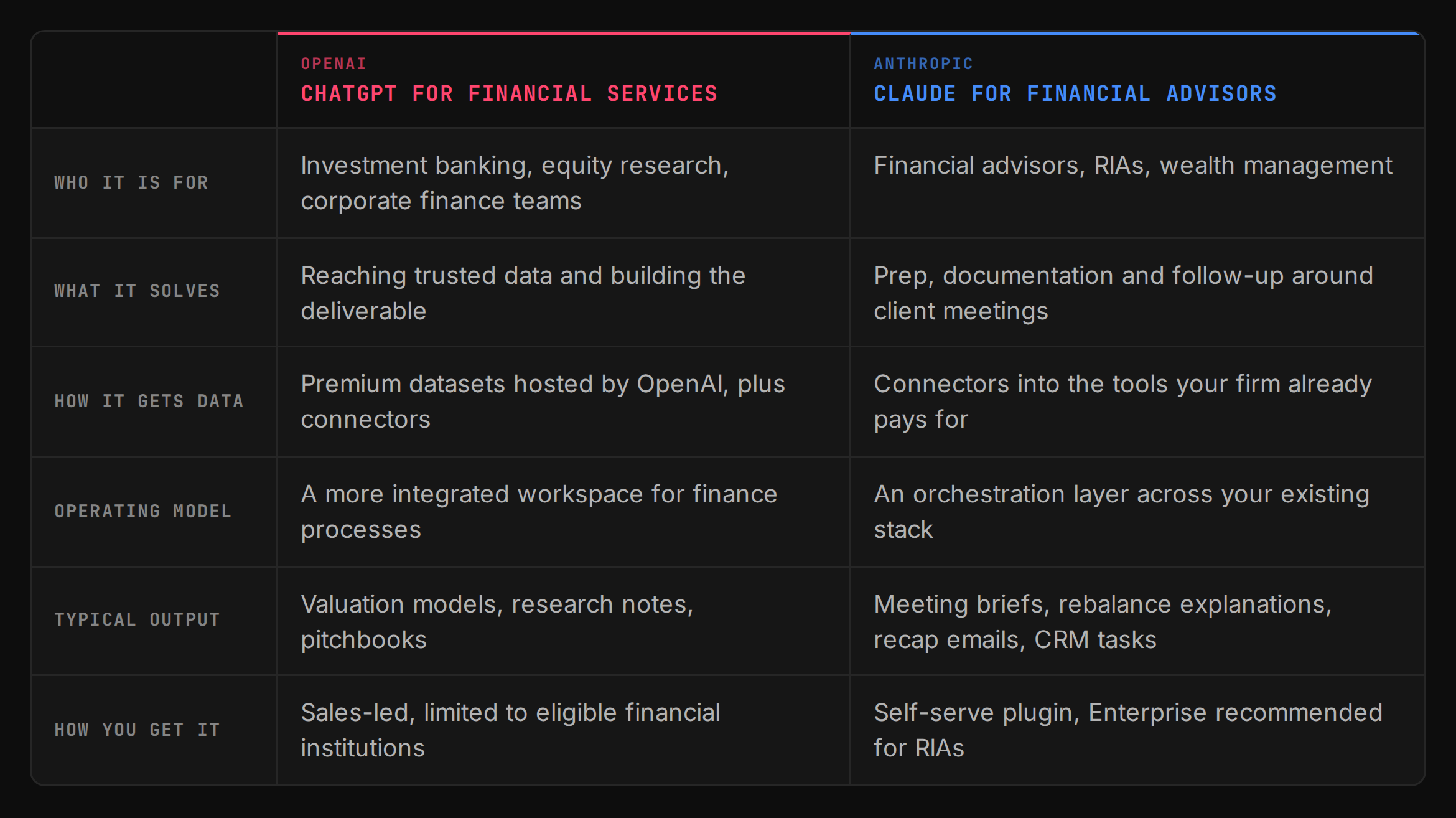
The pattern across both: the value has moved from the chat window to the connection. What the model can reach now matters more than how well it writes.
A separate ChatGPT plan for financial institutions, built on ChatGPT Enterprise, developed with Morgan Stanley and Evercore. The first focus is investment banking and equity research, and OpenAI's target workflows are specific: valuation analysis, LBO modelling, buyer screening, earnings analysis, pitchbook preparation.
It runs on GPT-6 Astra, with newer models available as they ship. Three things it does that general-purpose chat does not.
Reads financial documents properly. It works through figures, tables and the notes underneath them. OpenAI's benchmark for this is OfficeQA Pro, which tests finding and analysing information across US Treasury Bulletins including complex tables and footnotes, where GPT-6 Astra scores 69.9% against 60.2% for the previous model.
Traces figures back to source. Citations point at the specific table or passage behind a number, with the supporting text highlighted. On an adjusted EBITDA you can open the reconciliation, see which costs were excluded, and decide whether the treatment holds.
Produces the deliverable in your format. Administrators publish Excel, Word and PowerPoint templates centrally, so analysis comes back as a valuation model, research note or pitchbook already in house style. It saves the hour that usually goes on making the output look like it came from your firm.
Governance sits on ChatGPT Enterprise: SSO, SCIM provisioning, role-based access, no model training on business data by default, configurable retention, exportable logs, and separate workspaces for information barriers.
Premium datasets come indexed and hosted by OpenAI, switched on by default, with no separate provider contract and no connector setup.
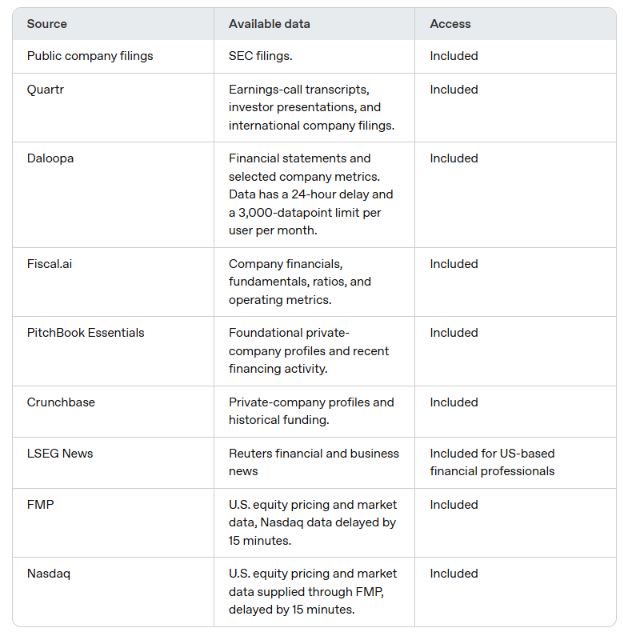
Included financial data sources. Source: OpenAI Help Center, September 2026.
Three caveats matter more than the list.
Included does not mean the full product. OpenAI states that bundled datasets provide selected coverage which may differ from what the provider sells directly. PitchBook Essentials is not PitchBook. Check the fields your process depends on before anyone cancels a subscription.
Almost none of it is live. Equity pricing runs at least 15 minutes behind, Daloopa carries a 24-hour delay and a monthly datapoint cap per user, and refresh schedules vary by source.
Anything beyond the list runs on your own subscriptions. OpenAI is working with S&P Capital IQ, LSEG, MSCI, Dow Jones Factiva and Moody's on shared sign-in, and the wider connector ecosystem passes 50, including FactSet, Preqin, Datasite, Box and Intapp.
OpenAI's Financial Services terms, updated September 16, 2026, cut against what people will assume they can do with the output. We are not lawyers, so treat this as a list of questions for whoever is.
You do not own the partner data inside your own output. The providers keep their rights, and an export button does not expand them.
PitchBook data may not go into your CRM. Flag this one internally. PitchBook's terms prohibit entering its data into a CRM or other database, exporting substantial portions as raw data, using it to train or ground a model, or using it to judge eligibility for employment, credit or insurance. PitchBook allows internal research and analysis, and stops at the point where the data gets written into a system of record, which collides with the workflow the whole category is selling.
Reuters content is US professional use only, and internal only. It is limited to professional users at eligible US firms, shareable internally in insubstantial amounts with the source credited, and kept out of press, mass media and the internet. A Reuters-derived line in a client newsletter is not covered.
Most partners prohibit model training on their data. PitchBook, Daloopa and Reuters all bar it. Nasdaq adds restrictions on open-environment AI models and redistribution.
The short version for a team lead: this data is for internal research and analysis. Moving it into other systems, into client-facing material, or into anything that trains a model is where the trouble starts.
A plugin connecting Claude to the custodians, portfolio platforms, CRMs and planning tools advisors already use, plus skills built around specific moments in an advisor's day. It is aimed at the advisor rather than the client, and Anthropic is deliberately not building a direct-to-consumer advisor.
What it does is orchestrate. Claude sits between the tools in your stack, takes what it needs from each, and hands back one thing: a meeting brief, a drafted explanation, a set of CRM updates waiting for approval.
The problem it targets, in Anthropic's own framing at the launch: advisors spend just 20% of their time with clients. The rest goes to assembling information and carrying it between systems that do not speak to each other.
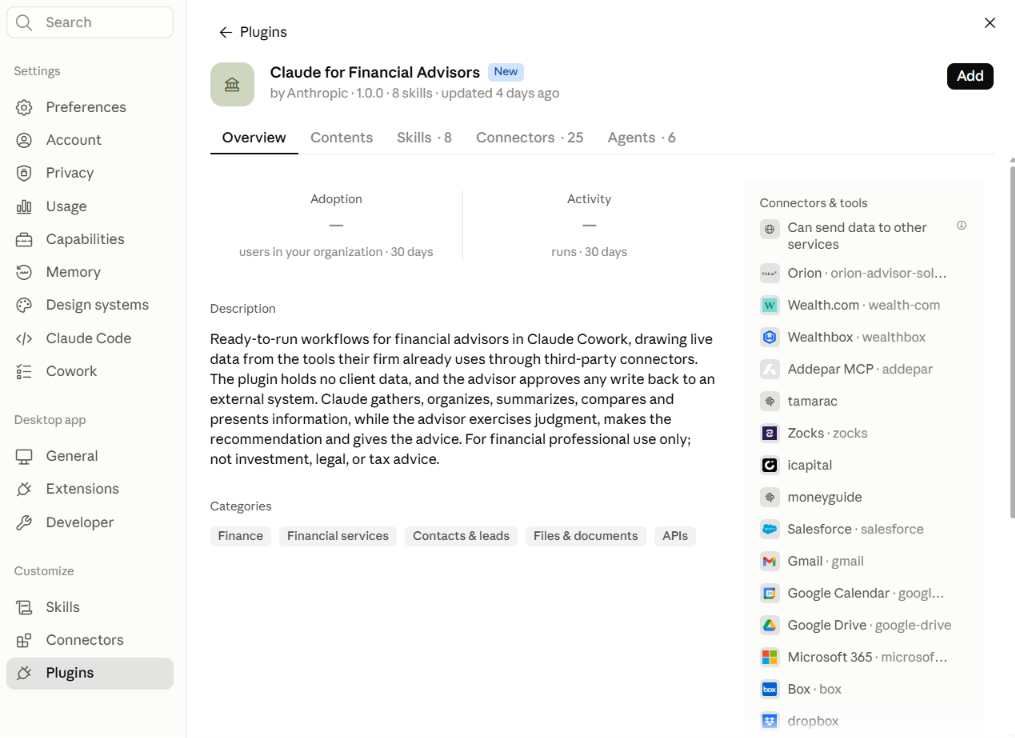
Install from the Plugins menu, then type /onboarding. Claude asks your role, the kind of firm you work at, which parts of your week cause the most trouble, and what your tech stack looks like, then surfaces the matching connectors for you to authorise one at a time. After that you run a skill with a slash command or by asking in plain English.
Connectors cover the working stack: Charles Schwab for custodial data, Addepar and SS&C Black Diamond for portfolio intelligence, Orion and Wealthbox for reporting and CRM, Envestnet for Tamarac and MoneyGuide, iCapital for alternatives, Wealth.com for estate and tax, BlackRock and Vanguard for model portfolios, Zocks for meeting capture. Plus email, Drive, SharePoint and Salesforce.
Skills handle one moment each: pre-meeting prep, post-meeting notes and follow-up, portfolio rebalance review, alternative investments brief, estate and tax brief, prospect intake, compliance review, advisor onboarding. Anthropic publishes them in an open repository, so firms can adapt them to their own service model.
The advisor stays in charge by design. Claude shows its plan before it writes anything, and a human approves, edits or denies it. Investment recommendations, client communications and compliance determinations all stay subject to human review. Claude logs in with your own credentials and sees only what you can see, with no shared service account behind it.
The calculations are not Claude's either. Language models are probabilistic, which is a problem in a regulated business, so the maths stays in the portfolio accounting and planning systems that already produce it. Claude pulls the finished figures and works across them. Anything that reaches a client came from the system of record.
On data, Anthropic does not train on what you put into Claude on Team or Enterprise, and that covers your prompts, whatever the connectors pull in, and what Claude sends back. For the due diligence file, compliance officers can pull the SOC 2 and ISO certifications and the data privacy addendum from trust.anthropic.com.
Which plan you are on is the one real cost. The plugin reads from live systems and writes back to them, and a regulator expects those changes on record. Team has no audit logs, so Enterprise is the only plan that works here.
Whether you have used AI daily for a year or barely at all, the same three habits separate the teams getting value from the ones with expensive unused licences.
Name the source, and check the two numbers that matter. "Using the Q3 10-Q I uploaded" beats "look up their Q3 numbers." Both products link figures back to source, and that link only helps if someone clicks it. Check the figures the recommendation rests on, not all of them.
Treat the output as a first draft, then make it repeatable. People expecting a finished deliverable quit in week one. People who edit get value immediately. Once a workflow produces the right output twice, write it down. Claude's skills are editable files you can eventually schedule, and OpenAI's published templates do the equivalent job for formatting. A good prompt saves twenty minutes once. A saved workflow saves it every week.
Start with one task, not the whole process. Pick the most repetitive information-assembly job in your week, the one you could explain to a new joiner in two minutes but that still takes forty. Run it the same way for a month before adding a second. The habit forms around the task, which is why one task beats a rollout.
For anyone leading a team, the failure mode is predictable. A firm buys licences, announces them, and six months later three people use them well while everyone else went back to copying and pasting. Budget for usage as well as seats, decide who owns the control configuration, and get the licensing rules written down before anyone connects a dataset.
One thing worth protecting: assembling the comp set and reconciling statements by hand is how analysts learned to smell a wrong number. When the model does the assembly, that learning has to move to reviewing and challenging its work.
Regulated activity still needs a human. Investment recommendations, client communications and compliance determinations are approval points, not automation targets. OpenAI states outright that its output is for research and does not constitute investment advice.
Citations reduce error, they do not remove it. A model can cite a real table and still draw the wrong conclusion from it.
Confidentiality controls need configuring. Both products support information barriers and role-based access, but only against a wall structure someone has actually mapped. Start with whoever owns your compliance policy, then hand the result to IT.
Plan structure. ChatGPT for Financial Services applies to an entire workspace, and standard Enterprise seats cannot sit alongside Financial Services seats in the same one.
Geography. Both launches are Americas-first. Reuters news is limited to US-based professionals and the market data is US equities. Anthropic says international expansion is coming without committing to dates.
Finance teams are getting tools built for their work faster than anyone has explained what to do with them. The gap is rarely the software. It is that nobody has shown the team which tasks are worth delegating, how to verify what comes back, and where the line sits between a draft and a decision.
AI Academy runs corporate training built around how your teams actually work, with content specific to your industry, your tools and your compliance reality. Your people leave knowing where AI helps their real work, where it does not, and how to apply it reliably rather than occasionally.
Learn More About Corporate Training
What is ChatGPT for Financial Services?
A separate ChatGPT plan for financial institutions, built on ChatGPT Enterprise and released in September 2026, bundling premium financial datasets, granular citations, firm templates and enterprise controls. It was developed with Morgan Stanley and Evercore, starting with investment banking and equity research. The plan applies to an entire workspace, so standard Enterprise seats cannot be mixed with Financial Services seats.
What is Claude for Financial Advisors, and how hard is it to set up?
A plugin from Anthropic, released in September 2026, connecting Claude to the custodians, portfolio platforms, CRMs and planning tools advisors use, plus skills for meeting prep, rebalance review, estate and tax briefs, prospect intake, compliance review and post-meeting follow-up. Setup is self-serve: install from the Plugins menu, type /onboarding, and a guided walkthrough asks about your role, firm and tech stack before surfacing the connectors to authorise.
Which one should a finance professional use?
It depends on the work. ChatGPT for Financial Services targets deal and research workflows: modelling, screening, earnings analysis, pitchbook preparation. Claude for Financial Advisors targets the client relationship: prep, documentation, follow-up, compliance review. Many firms will have reasons to run both.
What financial data is included, is it real time, and does it work outside the US?
The bundled sources are SEC filings, Quartr, Daloopa, Fiscal.ai, PitchBook Essentials, Crunchbase, LSEG News, and US equity pricing via FMP and Nasdaq. Coverage is selected rather than each provider's full product. Almost none of it is live: equity pricing runs at least 15 minutes behind and Daloopa has a 24-hour delay plus a monthly datapoint cap. Both launches are Americas-first, and Reuters news is limited to US-based professionals.
Can I use this data in client materials, or write it into my CRM?
Often not, and it differs by provider. OpenAI's terms make the partner data available for internal research and analysis, and providers keep their rights in it even inside your output. PitchBook specifically prohibits entering its data into a CRM or other database, and Reuters content is internal-use only in insubstantial amounts. Most partners also bar using their data to train models.
What does Claude for Financial Advisors cost, and why does it need Enterprise?
Enterprise starts at 20 seats minimum, $20 per user per month billed annually, which is $4,800, with usage billed separately at roughly $70 to $120 per month per active user. Firms registering before the end of September 2026 receive a $4,800 credit. Enterprise is required because Team has no audit logs, no role-based access controls and no compliance API.
Can these tools access my firm's data, and who can see it?
Only what you connect. Claude inherits each user's existing logins and permissions, with no shared service account. Both companies exclude business data from model training on their work and enterprise plans. Check your plan's specifics before connecting anything sensitive.
How reliable are the numbers these tools produce?
Better than general-purpose chat, because both are wired into licensed data and show their sources. The deeper answer is that neither is meant to do the deterministic math. Calculations stay in your portfolio accounting, planning and ERP systems, and the model orchestrates across them.
Will AI replace financial analysts and advisors?
Neither product is built that way. Index funds, discount brokerage and robo-advisors were each supposed to end the advice business and each became a tool advisors use. What is being automated here is assembly and documentation. Judgment and accountability stay with the professional.
What about compliance and the SEC Marketing Rule?
Claude's compliance skill screens client-facing language against SEC marketing rules and helps document review activities. The practical use is running a piece through it before it reaches your CCO, so the obvious issues are already fixed. Your CCO still signs off.


.png)